

A Practical Introduction to Open Business Architecture
1. Why O-BA Matters
Most organisations do not struggle to define strategy. They struggle to translate it into how the business actually operates.
Priorities are set, initiatives are launched, and transformation programs are funded. Yet over time, alignment weakens. Teams optimise locally, capabilities evolve independently, and operations continue to reflect historical patterns rather than strategic intent.
This is commonly described as the strategy–execution gap.
In practice, it is a structural issue.
There is no clear, formalised bridge between intent and delivery.
The Open Business Architecture (O-BA) standard, developed by The Open Group, addresses this gap by defining how strategy, structure, and operations are connected through a coherent architectural model.
2. How O-BA Sees the Organisation
O-BA models the organisation as a system of three interdependent domains:
- Strategy Domain, defining direction through vision, principles, and challenges
- Structure Domain, defining how the organisation is designed through capabilities, value streams, and organisational elements
- Operational Context Domain, defining how execution is realised through resources, outcomes, and implications
These are not layers. They function as an interdependent system.
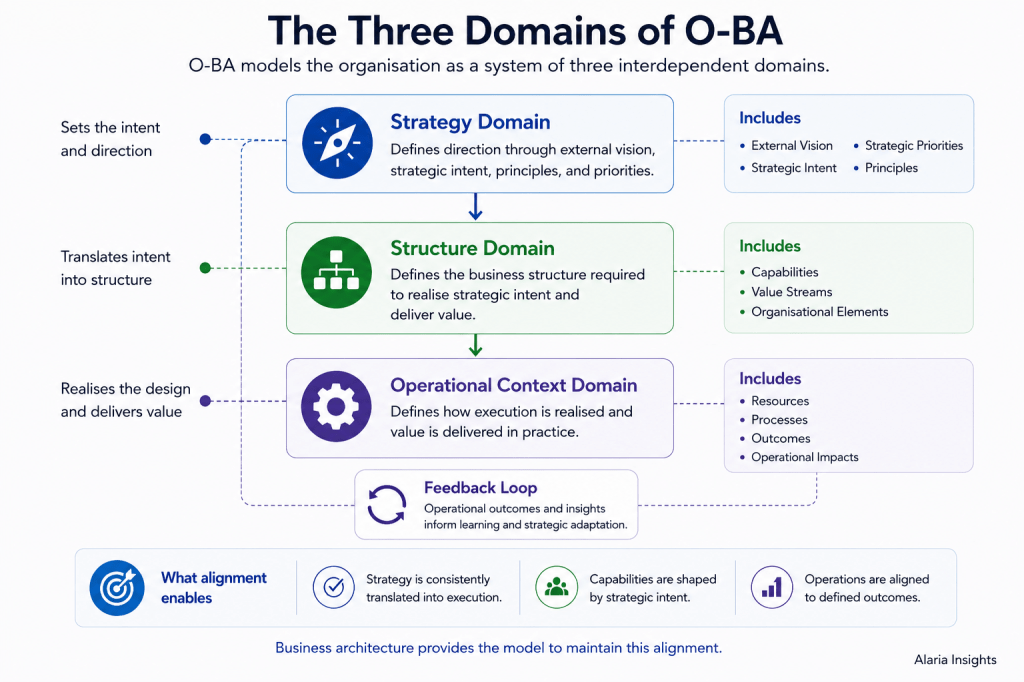
Strategy shapes structure.
Structure enables and constrains operations.
Operations generate feedback that informs strategy.
When these domains are not aligned:
- Strategy cannot be translated into execution
- Capabilities develop without clear purpose
- Operations optimise without reference to outcomes
Business architecture provides the model to maintain this alignment.
3. Transformation as a Continuous Lifecycle
A key principle in O-BA is that transformation is continuous.
It is not a project with a defined end state. It is a continuous cycle:
- Idea, capturing signals and opportunities
- Vision, defining direction
- Strategy and implementation planning, formalising intent
- Execution, mobilising capabilities and resources
- Optimisation and learning, feeding back into the next iteration
This lifecycle operates as a loop.
Without it, strategy becomes static while the organisation evolves independently. Misalignment becomes inevitable.
In practice, this means strategy is continuously shaped by operational feedback, not defined once and executed unchanged.
4. Common Language as a Structural Capability
Transformation depends on shared understanding.
O-BA introduces a defined common language, which evolves into a controlled vocabulary as the practice matures. Core concepts such as capability, value stream, competence, actor, and stakeholder have precise meanings within the metamodel.
This is not a theoretical discipline. It directly shapes how decisions are made.
A common language enables:
- Consistent interpretation of strategy
- Clear communication across domains
- Reliable decision-making
- Reduced ambiguity in transformation initiatives
Without it, alignment depends on interpretation rather than structure.
5. Value Streams as the Bridge Between Strategy and Delivery
Value streams are the central mechanism connecting strategy to execution.
In O-BA, a value stream represents the sequence of activities an organisation undertakes to deliver value in response to demand. It includes sourcing inputs, collaborating with partners, creating value internally, and delivering value to stakeholders.
This shifts the focus from organisational functions to value delivery.
Value streams enable organisations to:
- Group capabilities around value delivery
- Define how strategic intent is realised
- Maintain a consistent enterprise-wide structure
- Connect value delivery to execution
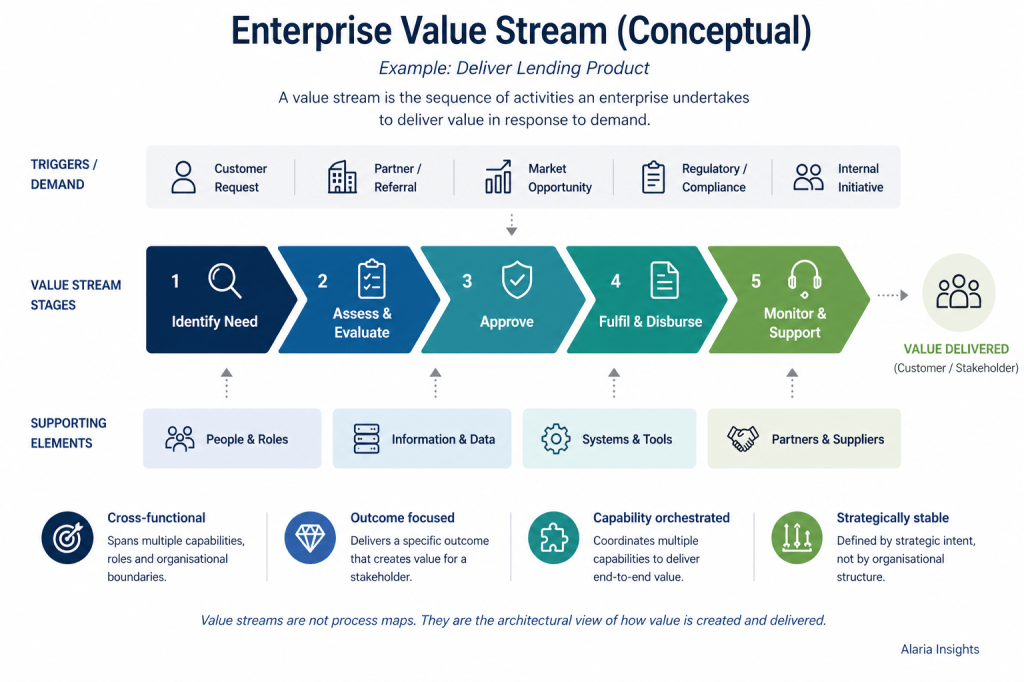
While value streams define how value is structured and delivered, they do not capture how value is experienced.
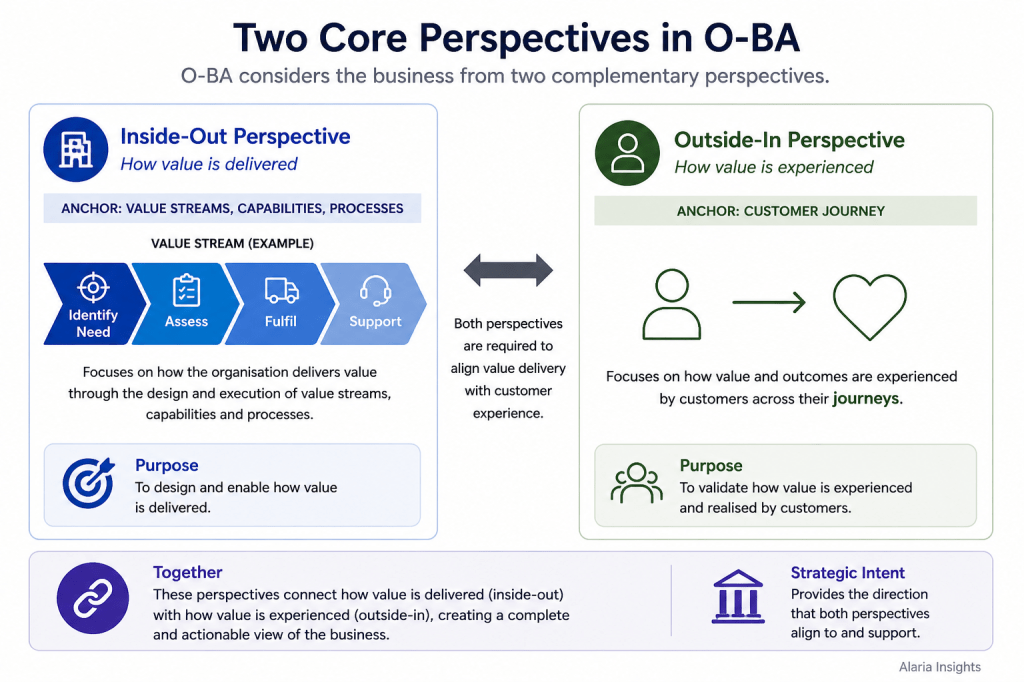
To achieve alignment, value streams must be considered alongside the customer journey.
O-BA distinguishes between two complementary constructs:
- Value Stream (inside-out), defining how the organisation structures and orchestrates capabilities to deliver value
- Customer Journey (outside-in), defining how value is experienced by the stakeholder
The value stream defines how value is produced.
The customer journey defines how value is experienced.
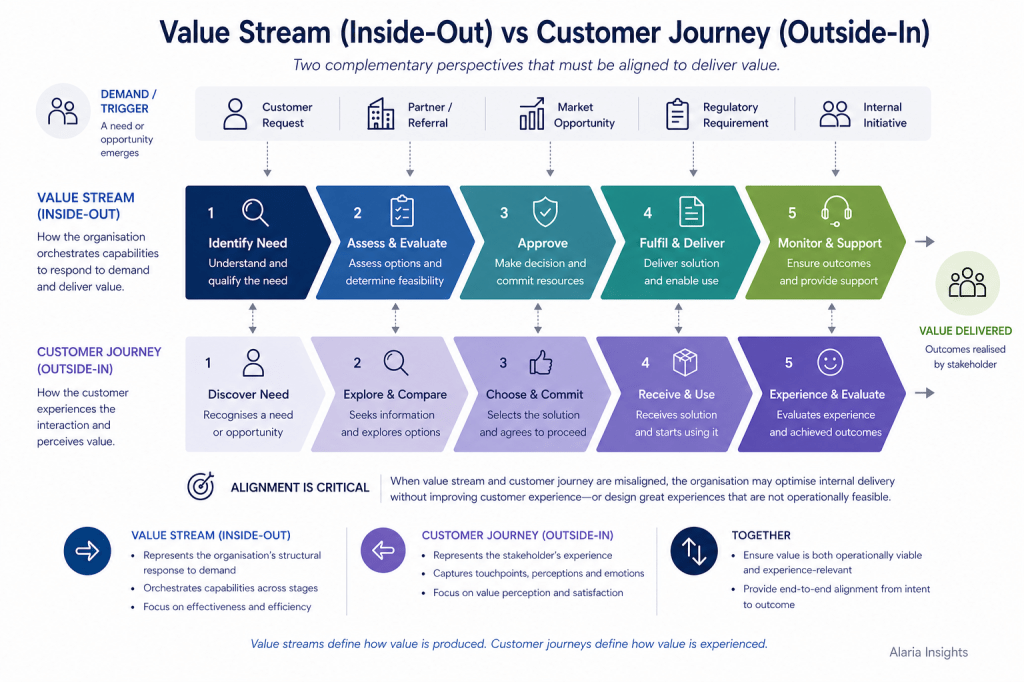
This alignment becomes clearer when value stream stages are directly mapped to customer journey touchpoints, making gaps and dependencies visible.
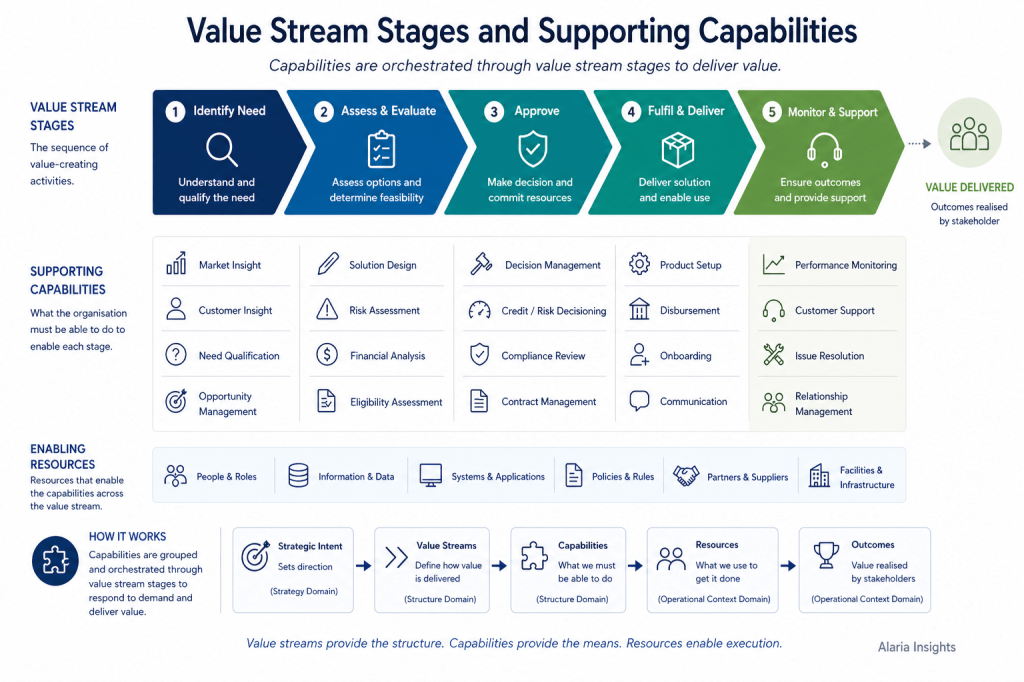
6. Making It Practical: Capabilities and Value Streams
Capabilities represent what the organisation can do.
Value streams represent how those capabilities are orchestrated to deliver value.
Together, they provide a clear structure for execution:
- Value stream stages define the flow of value
- Capabilities enable each stage
- Resources enable capabilities
This creates a direct link between strategy and execution.
Processes operate within this structure.
While value streams define how value is delivered at a conceptual level, processes describe how that delivery is operationalised in practice. They provide the detailed flow of activities required to execute each stage of the value stream.
This distinction is critical. Value streams remain stable and aligned to strategy, while processes evolve as the organisation improves efficiency, adopts new technologies, or responds to change.
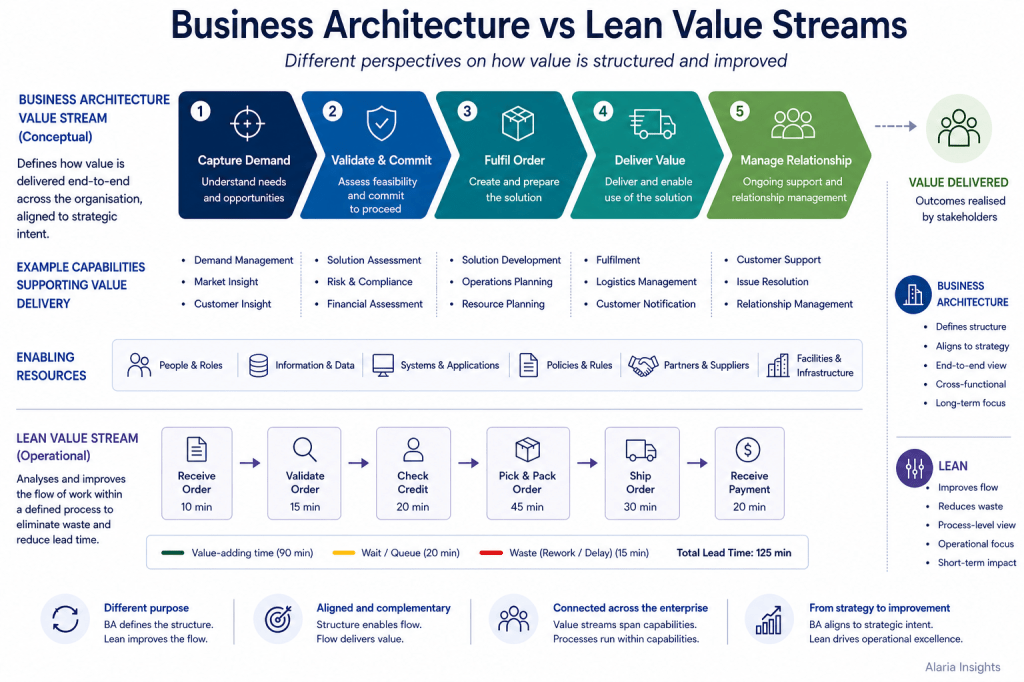
7. Business Architecture vs Lean Value Streams
The term “value stream” is used across disciplines, but with different intent and meaning.
| Feature | Business Architecture Value Streams | Lean Value Streams |
|---|---|---|
| Purpose | Align capabilities with strategic intent | Analyse and improve flow |
| Nature | Conceptual and stable | Operational and dynamic |
| Scope | Enterprise-wide, multi-stakeholder | Process-level, transactional |
| Focus | Value creation and delivery structure | Efficiency, waste, and lead time |
These perspectives are complementary.
Business architecture defines the structure of value.
Lean methods improve the flow within that structure.
8. Traceability: Making Alignment Visible
Alignment is only meaningful if it can be demonstrated.
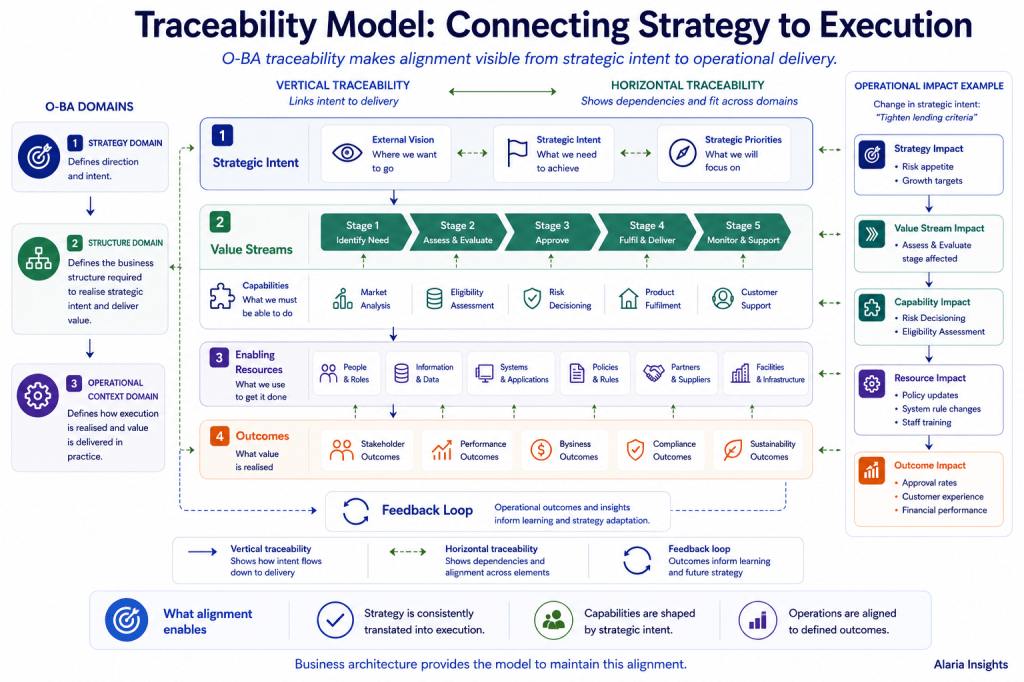
In O-BA, alignment is achieved through traceability, which operates through two complementary mechanisms:
- Vertical traceability, linking vision and strategic intent to capabilities, value streams, and resources
- Horizontal traceability, exposing dependencies across domains and ensuring strategic fit
This enables implication mapping.
For example:
A change in strategy, such as tightening lending criteria, can be traced through the organisation:
- Impacted value stream stages
- Required capability changes
- Affected processes and systems
- Resource and cost implications
This makes the consequences of change explicit and manageable across the organisation.
Without traceability:
- Decisions are made in isolation
- Dependencies are missed
- Alignment is assumed rather than verified
9. What Changes When O-BA Is Applied
When this model is applied consistently, organisations shift from fragmented execution to aligned delivery.
In practice, this results in:
- Clear linkage between strategy and initiatives
- Improved prioritisation based on impact
- Reduced duplication across teams
- Stronger governance and accountability
- Faster, more informed decision-making
The focus moves from activity to alignment.
10. Closing Reflection
The effectiveness of a strategy is not determined by how well it is written.
It is determined by how clearly it is translated into execution.
O-BA provides a structured way to make that translation explicit.
Value streams connect intent to delivery.
Capabilities provide the means.
Traceability maintains alignment.
A common language ensures consistency.
The lifecycle sustains continuity.
Together, these elements form the structural bridge that most organisations lack between intent and execution.
A simple question remains:
Can your organisation trace its strategy through value streams and capabilities into execution, or is execution still driven by inherited structures rather than strategic intent?


 Alaria Insights
Leave a comment